Friday, March 31, 2023

Iconic Image 19

Welcome back viewers

This month's Iconic Image is...

The Marine on the Tank

Intro

This photograph was taken in February of 1968, during the Tet Offensive. It depicts a group of wounded American marines being placed on a tank to be evacuated. In the foreground is an unconscious marine whose being held by comrade. He is unconscious and barely clinging to life after being shot in the chest. This image would come to symbolize the suffering of American servicemen during the one of the worst battles of the Vietnam War.

Part I

The battle of Huê began on January 31, 1968. It was part of the North Vietnamese Tet Offensive to seize multiple cities and towns across South Vietnam. Although they caught American and South Vietnamese forces by surprise, most of their attacks were beaten back with heavy casualties within only a few days (some even hours) of fighting. The exception was the ancient city of Huê. In this city, more than 6,000 Viet Cong and NVA soldiers attacked from three sides and successfully captured multiple footholds and important buildings within the first night of combat. 

In response four American army battalions and three marine corps battalions were assembled to assault the city. They quickly ran into stiff resistance as they entered. They were literally forced to take the city back street by street and house to house. It was a painstakingly slow process. And casualties among both sides were very high.

Part II

Among the marines was a photographer named, John Olson. Olson was working for the Stars and Stripes newspaper. During the battle of Huê, he took dozens of photographs of American servicemen in combat (he focused mainly on the marines). 

On February 17, John Olson noticed a group of wounded marines being loaded onto an M49 Patton tank. As each of them climbed on, Olson noticed one of the marines was completely unconscious. His torso was almost completely wrapped in bandages and multiple IVs were in his arms. The marine was barely breathing. Olson quickly aimed his camera at the group, zoomed in on the unconscious marine on the tank's left track, and took the photograph.

Part III

The identity of the wounded marine on the tank has been debated ever since the photograph was published. Olson himself never found out who the marine was (nor any of the others on the tank). Mark Bowden (the author of Huê 1968, Killing Pablo, and Black Hawk Down) believes that the marine was, Private First Class Alvin Bert Grantham. Grantham was an 18 year old from Mobile, Alabama. He had dropped out of high school with a close friend and enlisted in the Marine Corps.

During the battle of Huê, Grantham was with a platoon of 51 marines. On the morning of February 17, Grantham was manning a machine-gun in an old building when an AK-47 round struck him directly in the torso. The impact blew Grantham back 10 feet, ripped a hole in his chest, pierced his lung, causing massive blood loss. His fellow marines quickly began trying to save his life. They were able to slow down the bleeding by plugging the hole with the plastic wrap of Lucky Strike cigarette packs. He later remembered being carried to a nearby tank and loaded onto it with other wounded marines.

However, a photo forensics specialist named Michael Shaw (the New York Times Magazine), identified the marine as Pfc. James Blaine from Spokane, Washington. Blaine was shot in the chest on February 15. Sadly, unlike Grantham, Pfc. Blaine was mortally wounded. He died in the hospital hours later. Most researchers however, have disregarded this claim due to Olson's account of taking the photograph on February 17 (Blaine was wounded on February 15). This makes it highly unlikely that Blaine is the marine in the photograph.

Epilogue

The battle of Huê ended on March 2, 1968 when American and South Vietnamese forces finally killed the last remaining NVA soldiers within the ancient Citadel. By then the Americans had suffered 216 killed and 1,584 wounded. The South Vietnamese army lost 452 killed and 2,123 wounded. Communist casualties are believed to be at more than 2,400 killed and 3,000 wounded. In addition, more than 5,000 Vietnamese civilians were killed as well while most of the city's buildings were destroyed. Although the battle of Huê was military victory for the Americans, the battle had severely affected the American perception of the Vietnam War. For Americans in Vietnam, the battle of Huê was the beginning of the end of their intervention as many more American citizens began to oppose the conflict.

Despite his severe injuries, Grantham was evacuated to a field hospital (he was almost placed in a body bag before another marine noticed movement). He was then given a massive emergency surgery by vascular surgeon Dr. Mayer Katz. During the operation, Doctor Katz was forced to remove two of Grantham's ribs and part of his right lung before inserting two chest tubes to drain the wound. After being stabilized, Grantham was then airlifted to a Navy Hospital ship and then again to Japan where he spent a year in recovery. In 2017, Grantham was reunited with Doctor Katz and thanked him for saving his life.

For his photographs depicting the Vietnam War, John Olson was awarded the Robert Capa Gold Medal in 1968. Today, the photograph of the wounded marine on the tank is still seen as one of the most emblematic images of the war. It tells a great story of a single marine's terrible injury and his remarkable recovery. It also shows the great suffering of American servicemen during one of the most brutal battles of the Vietnam War. 

https://www.vanityfair.com/news/2017/05/the-true-story-of-the-marine-on-the-tank-vietnam-war

https://www.nytimes.com/interactive/2019/02/19/magazine/vietnam-war-photo-wounded-marine.html

https://nieman.harvard.edu/stories/whats-in-a-50-year-old-photo-the-lingering-gutwrench-that-was-the-vietnam-war/

https://www.northwestgeorgianews.com/a-b-grantham-the-marine-on-the-tank/article_4c92fce7-0acb-545c-ba99-6cb822cd33d7.html

https://newseumed.org/tools/artifact/marines-and-tet-battle-changed-vietnam-war

Monday, February 27, 2023

Iconic Image 18

Welcome back viewers

This month's Iconic Image is...

The Battle of Sedan


Intro:

This photograph was taken on September 1, 1870. It depicts soldiers standing in a line and firing their weapons in the direction of the camera. Behind them, are other soldiers advancing through a small town. Some of them have are lying on the ground either dead or wounded. This long forgotten image was the very first photograph to depict soldiers in combat.

Part I

In July of 1870, all of Europe's eyes were on the countries of France and Germany. This was due to the Northern Kingdom of Prussia annexing all of the kingdoms of Southern Germany into one country. These included the kingdoms of Saxony, Bavaria, Württemberg, Baden, and Hesse. When these kingdoms were annexed into Prussia, the German army swelled to more than triple its original size. French fears were further stoked when Germany attempted to forge an alliance with the country of Spain. 

On July 19, the French Emperor Napoleon III declared war on Germany (at the time called: the Northern German Confederation). Since the bulk of the German leadership came from the Kingdom of Prussia, this conflict would be forever known as, the Franco-Prussian War. It would become one of the most pivotal and brutal wars in the latter half of the 19th century.

Part II

Things quickly took a very bad turn for the French Army. They found themselves both severely outnumbered and outgunned by their foes. The German/Prussian armies were able to win swift and devastating victories in Northern and Eastern France. On August 19, the German Army laid siege to the French city of Metz. 

Emperor Napoleon III decided to personally lead a relief force of 120,000 soldiers (the Army of Châlons) to relieve the besieged garrison at Metz. When a detachment under the command of General Patrice MacMahon arrived at the commune of Beaumont-en-Argonne, they were ambushed by Bavarian soldiers and driven back with heavy losses. General MacMahon then pulled his army back to the town of Sedan with the intention of resting and resupplying. Unfortunately, this gave the German Army the perfect opportunity to corner them in an obsolete fortress that could not be defended against a prolonged attack.

On September 1, the German Army under General Helmuth von Moltke advanced on Sedan. The Army of Châlons engaged the Germans at the village of La Moncelle but were forced back with heavy casualties. The German Army then counterattacked and drove the French all the way back to Sedan. Simultaneously, the Royal Bavarian Corps attacked the French right flank at the town of Bazeilles. Although the French garrison (made up of marines and local towns people) inflicted heavy losses on the attackers they too were eventually forced to retreat (the Bavarians later burnt the town in retaliation for their high casualties).

At 11 AM, the German artillery began to relentlessly bombard the French defenses at Sedan. One by one, each French defense was obliterated by the German guns. The few defenders who survived were then easily picked off by the advancing German infantry. Within the hour, the Army of Châlons was surrounded in the Sedan fortress. Any attempt to breakout of the encirclement by the French was beaten back with heavy casualties. By the end of the day, Napoleon III called off any further attacks and hoisted a white flag on the fortress walls of Sedan. The next day, the French surrendered. 

Part III

The photograph of the battle of Sedan was taken from a hill overlooking the French village of La Moncelle. It depicts a line of soldiers advancing on the enemy position where the photographer happened to be standing. Some of them are lying on the ground (dead or wounded) and many are still on their feet with their rifles raised. The identity of the photographer is unknown.

Historians and researchers have debated as to wether the soldiers in the foreground are attacking Prussians of the German Army or counter-attacking French soldiers of the Army of Châlons. Many of them believe that it's the latter. According to the angles of the shadows on the house in the corner, the photograph was snapped around 15:00 (3 PM). This was when the Army of Châlons attempted to breakout of the encirclement through the communes/villages of La Moncelle, Baizelles, and Balan. Since the German attack is reported to have happened in the late morning/midday, it seems highly probable that the soldiers depicted are French and that the photograph was taken from the German position at La Moncelle. 

Incredibly, a second image was successfully taken just minutes later. This one seems to depict the attackers retreating under a withering fire. The defending soldiers are now visible to the viewer (though the viewer still cannot quite make out their identities). It is likely that the photographer moved his/her camera further back in order to avoid getting caught in the crossfire of the battle (it's also possibly from a second photographer). Considering the fact that the French breakout attempts were all beaten back, it becomes much more probable that the soldiers depicted in the first image are French and not German.


Epilogue

For the French, the battle of Sedan was the beginning of the end. At the end of the battle, nearly the entire Army of Châlons was either killed or forced to surrender (120,000 soldiers). Among those captured, was Napoleon III and three high ranking generals of the French Army. The Germans had only suffered 1,310 killed, 6,443 wounded, and 2,107 missing. It is considered today to be one of France's most devastating military defeats. 

Napoleon III's capture caused the government of the Second French Empire to collapse and reform under the Third French Republic. Fifteen days later, the German Army reached the city of Paris and laid siege it. Four months later, Paris surrendered and the Franco-Prussian War was over. France was forced to cede it's easternmost region (Alsace-Lorraine) to Germany. However, lasting animosity between the two countries eventually culminated in a far more devastating conflict (World War I). And at the end of this war, the Alsace-Lorraine region was returned to France.

In the aftermath of the battle, the photograph was printed in newspapers and reprinted on postcards. Sadly (like so many other images before and after), it has largely faded into obscurity and very few people know of its historical significance. However, this photograph still represents a significant development in the history of battlefield photography. It was the very first photograph that successfully captured soldiers in combat. And it would not be the last. 

https://www.napoleon.org/en/history-of-the-two-empires/articles/the-battle-of-sedan/

https://www.artstor.org/2016/11/11/seeing-is-believing-early-war-photography/

https://www.thoughtco.com/franco-prussian-war-battle-of-sedan-2360809

https://i.imgur.com/GQgAtod.png

Monday, January 9, 2023

Iconic Image 17

Welcome back viewers

This month's Iconic Image is...

The explosion of the USS Shaw


Intro:

This photograph was taken on December 7, 1941. It shows a massive explosion in the background of the image and billowing black smoke from distant fires. In the middle of the image, one can see the faint outline of a ship. This photograph would become a symbol of one of the most infamous days in American history. It would also come to symbolize the nation's incredible ability to repair and recover from terrible tragedies.

Part I

The day of December 7, 1941, began like any other day for the people of Oahu in the Hawaiian Islands. A large fleet of American battleships, cruisers, destroyers, and a few submarines were stationed at the island's navy base, Pearl Harbor. At 7:55 AM however, American sailors and marines began to notice a large number of planes appear in the sky. The planes were Japanese fighters and bombers that began to attack the American ships while they were still anchored in the harbor. Within just minutes, dozens of ships were on fire.

The main targets for the attackers were the eight American battleships anchored within the harbor. Their large size and moorings made them easy targets for the attackers' torpedos and bombs. At 8:06, a single bomb penetrated through the deck of the USS Arizona all the way to the magazine and detonated. The explosion ripped the ship in two and killed 1,177 out of its 1,512 man crew. What remained sank to the bottom of the harbor. 

Another battleship (USS Oklahoma) was hit by three torpedos and began to roll to her port side. When two more torpedos slammed into her, the ship completely capsized. In just 12 minutes she rolled over until her masts dug into the mud on the bottom. Dozens of her sailors became trapped within her hull (only 34 would be rescued after the attack). Those that were fortunate enough to escape were strafed by the attackers as they attempted to swim ashore. In all, the USS Oklahoma would lose 429 of her crew.

Part II

One of the destroyers that was anchored in Pearl Harbor was the USS Shaw (DD-373). When the attack began the Shaw was anchored to the auxiliary floating dry dock, YFD-2. Three bombs hit the ship during the attack. Two of them struck the forward machine gun platform, and one went through the port wing of the bridge. Attempts to control the fires proved to be futile, and the crew quickly fled the ship. Half an hour after she was hit, the fires reached the ship's forward ammunition magazines and caused a massive explosion that completely tore off her bow. Almost immediately after the explosion, the destroyer sank. 

The moment of her detonation was captured by a photographer on the shore showing the massive fireball spreading into the sky and shooting debris in all directions. Behind the exploding Shaw, the billowing black smoke from burning ships easily dwarf the destroyer. The image clearly captures the devastation and the damage of the Attack on Pearl Harbor. The identity of the photographer is unknown.

Epilogue

The Attack on Pearl Harbor caused terrible damage to the American Navy. A total of four battleships had been sunk and another four severely damaged. Four destroyers (including the Shaw) were also sunk or damaged along with three battle cruisers, an ex-battleship (USS Utah), a minelayer, a seaplane tender, a harbor tug, a repair ship, and the floating dry dock (YFD-2). In addition, more than 300 American planes were destroyed or damaged at the airfields. Approximately 2,335 soldiers, sailors, and marines were killed and 1,143 were wounded. A further sixty-eight American civilians (including eleven children) were also killed in the attack. 

The next day at 12:30 PM, President Franklin Delano Roosevelt gave his famous Day of Infamy Speech and asked the American Congress to declare war on Japan. Less than an hour later at 1:10, the Congress did so. Four days later, Nazi Germany declared war on the United States. As a result, World War II officially became a global conflict.

Despite all of the damage that had been inflicted on the American Navy in the attack, nearly all of the damaged ships were successfully raised and repaired. Only three ships, (USS Arizona, USS Oklahoma, and the USS Utah) were deemed total losses. One of the ships that was repaired was the USS Shaw

Although she was initially thought to be a total loss, the ship's machinery had only suffered minor damage. In mid-December, the destroyer was lifted out of the water onto the harbor's marine railway and measured for a temporary bow which was attached in January of 1942. In February the Shaw sailed from Pearl Harbor to San Francisco, California, to undergo further repairs and rearmament. On August 31, 1942, the ship returned to Pearl Harbor with a new crew and ready for action. The Shaw went on to participate in the military campaigns of Guadalcanal, the Santa Cruz Islands, Saipan, Cape Gloucester, Guam, and the Philippines. She rescued survivors from stricken ships, escorted convoys, covered infantry, and guarded against Japanese submarines. During World War II, the Shaw was awarded eleven battle stars (awards to the crews of American ships for service in war). The ship was decommissioned in October, 1945, and sold for scrap in July of 1946.


The image of the explosion of the USS Shaw became one of the most famous and symbolic photographs of the Attack on Pearl Harbor. It captures the ferocity of the attack and its tragic consequences. However, one thing that it also came to symbolize was how the attack was ultimately a failure. As devastating as it was, the Japanese had severely underestimated the power of the American war-machine. The fact that nearly every American ship was repaired and returned to service proved that in the long term, the surprise attack on Pearl Harbor did not succeed in destroying the American Navy nor did it even damage it in the long run. All it really did, was bring the United States into World War II and unleash the full might of its military on the Axis Powers. That is what the image truly represents.

https://www.history.navy.mil/our-collections/photography/wars-and-events/world-war-ii/pearl-harbor-raid/attacks-in-the-navy-yard-area/uss-shaw-during-the-pearl-harbor-attack.html

http://www.historyofwar.org/articles/weapons_USS_Shaw_DD373.html

https://ww2db.com/ship_spec.php?ship_id=1843

https://www.erbzine.com/mag5/0508.html

Thursday, December 1, 2022

Iconic Image 16

Welcome back viewers

This month's Iconic Image is...

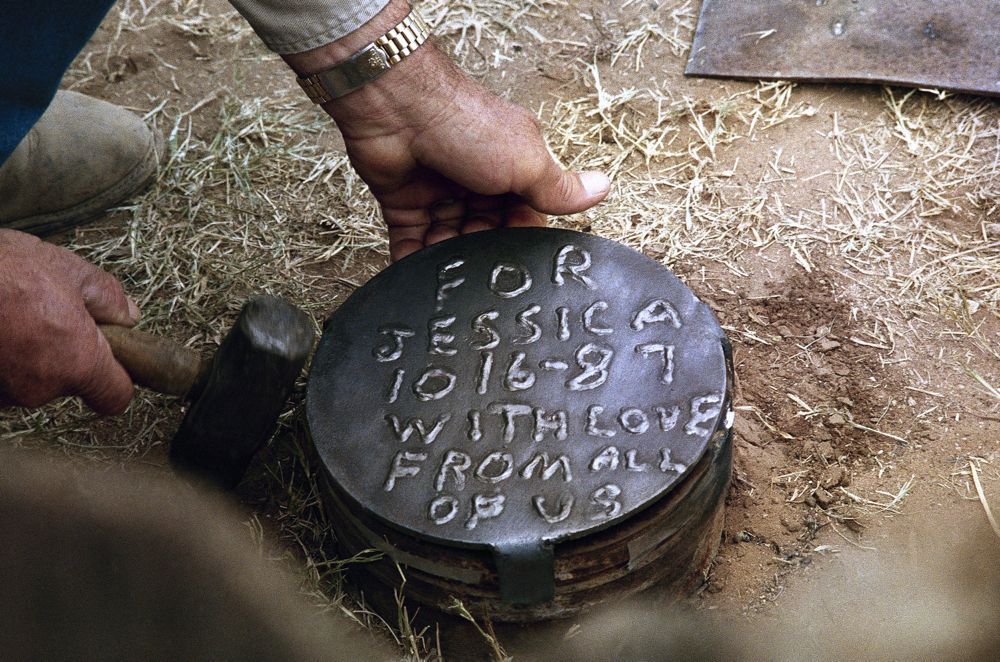
The Rescue of Jessica McClure 


Intro

This photo was taken on October 16, 1987. It depicts a group of men holding a baby girl wrapped in bandages while strapped to a spine board. The looks on their faces are a mixture of relief and joy. This image would come to symbolize the dramatic conclusion of a rescue that for two whole days had captured the attention of the whole country. 

Part I

The incident all began on the morning of October 14 in Midland, Texas. An 18-month old toddler named, Jessica McClure was staying at her aunt's daycare center while her parents were at work. While playing in the backyard, Jessica fell through the opening of an 8-inch-wide unused water well pipe. Her aunt heard Jessica crying from the well pipe but could not reach her. She then quickly called 9-1-1. Fireman and police officers arrived on the scene within minutes. They quickly deduced that Jessica had fallen approximately twenty-two feet down the well pipe and could not be pulled free from the surface. The only way to save her was to drill a hole into the ground parallel to the well pipe, somehow cut into the pipe, and pull Jessica free.

The rescuers found that the pipe was surrounded by dense rock that was too thick for jack hammers to drill through. They were forced to use a new digging tool called a, water jet cutter. The water jet cutter uses an extremely high-pressure jet of water (or other abrasive substance) to cut through very hard surfaces at great speed. It is typically used for mining.

The rescuers were able to successfully drill a hole that was three feet in diameter and thirty feet down. They then began to slowly dig a tunnel towards the well pipe. Once the tunnel was completed, they used pneumatic drills to cut into the pipe. Upon peering in they spotted one of Jessica's legs. They then inflated two industrial-type balloons beneath Jessica to prevent her from falling further into the pipe after being pulled free. Once that was done, paramedic Robert O'Donnell attempted to pull Jessica free but was unable to do so. He realized that the girl was stuck in a split with one of her legs pressed against her body. They were forced to dig a bit further to widen the well-pipe. After another hour of digging into the earth, Robert O'Donnell was finally able to inch his way through the tunnel and wrench Jessica free.


Part II

Jessica was then placed on a spine board and hoisted up through the hole. Her head was bandaged and she was carried to an ambulance. As soon as she was visible, the whole crowd erupted in applause. Multiple news anchors (who were reporting live) caught the moment that Baby Jessica finally emerged from the hole. She had been trapped in the well pipe for more 58 hours.

Among the rescuers were hundreds of reporters and photographers. One of them was Scott Shaw of the Odessa American newspaper from Ector County. Like so many others, he kept his camera at the ready for the moment Jessica was rescued. As soon as he noticed Jessica being carried up by a rescuer, he snapped a quick photograph of her being handed to a paramedic.

Epilogue

Jessica McClure was rushed to the hospital where doctors attempted to treat her injuries. Fearing that her right leg had suffered gangrene due to it being pinned against her body for more than 50 hours, doctors used a hyperbaric treatment. In the end, they only had to amputate one of Jessica's toes. Other than that, she made a full recovery from her ordeal. She grew up, got married, and is currently happily living in Texas with three kids. She has no memory of the entire ordeal. The well pipe that she fell into was later sealed off so that no child could ever fall into it ever again.


The picture by Scott Shaw of Jessica's rescue would go on to receive the Pulitzer Prize for Breaking News Photography for the year 1988. Today, the rescue of Jessica McClure is remembered as a remarkable story of survival and incredible courage to saving an innocent child from a tragic death. President Ronald Reagan was quoted as saying, "Everybody in America became godmothers and godfathers of Jessica while this was going on". It is a story that will always deserve to be told.

https://www.upi.com/Archives/1988/03/31/Scott-Shaw-of-the-Odessa-American-said-he-was/9084575787600/

https://www.pennlive.com/nation-world/2019/10/ill-never-forget-her-singing-winnie-the-pooh-the-rescue of-baby-jessica-in-1987.html

https://www.history.com/this-day-in-history/baby-jessica-rescued-from-a-well-as-the-world-watches

http://articles.latimes.com/1987-10-17/news/mn-3702_1_jessica-mcclure


Friday, October 21, 2022

Iconic Image 15

Welcome back viewers

This month's Iconic Image is...

The last Barbary Lion


Intro

This photograph was taken from an airplane high above a rocky cliff face in the year 1925. It depicts a male lion walking alone on the sand parallel to the cliff face. The image would become a symbol of tragic loss and lessons that needed to be learned by humanity.

Part I

The African lion is one of the most iconic animals that lives on the continent of Africa. Although there is only one actual species (Panthera Leo) there were a total of seven different sub-species of lions that inhabited the continent of Africa and also Asia. One of them was the Barbary lion (aka: North African lion or Atlas lion).


The Barbary lion was native to the northern coast of Africa (the Barbary Coast). Its range stretched from Egypt all to way to Northern Mali. It was highly prominent in the countries of Tunisia, Algeria, and Morocco. Its main diet included wild boar, Barbary sheep, red deer, and gazelles. A fully grown adult usually measured between seven to eight feet long (males could measure more than nine feet) and weighed more than 600 pounds. The Barbary lion's most notable feature was the male's incredibly long mane. The mane of the male extended from the shoulders all the way to the underbelly and measured between three to eight inches long.

Unfortunately, the Barbary lion's habitat and diet frequently put it in conflict with another species that lived on the Barbary coast: humans. Sometimes, the Barbary lion hunted domesticated cattle and also occasionally attacked humans. Since the times of the Ancient Rome, Barbary lions were often hunted and killed for sport (many of them were used to fight gladiators in the Colosseum). By the 18th century, bounties were being paid for anyone who shot and killed a Barbary lion. This caused the population of lions on the Barbary coast to decline much faster than they could recover.

Part II

The photograph of the Barbary lion taken by a military photographer named, Marcelin Flandrin in the year 1925. Flandrin was flying on the Casablanca-Dakar air route over the Atlas Mountains. As the aircraft he was in passed over a large cliff face, Flandrin noticed something moving down on the sand. He realized to his astonishment, it was a male Barbary lion. By the turn of the 20th century, Barbary lions had become so scarce that nobody had seen one in the wild since the 1890s. Due to the air route of the flight, it is likely that the photograph was taken over the countries of either Morocco or Mali. The lion is casually walking on the sand in complete solitude (its tracks still visible behind it). It is probable that this lion was one of the very last of his kind in the wild. 

Epilogue

This photograph would be the very last to ever be taken that depicts a Barbary lion in the wild. The last recorded shooting of a wild Barbary lion took place in 1942, in the Moroccan part of the Atlas Mountains. And the last known sighting of a Barbary lion in the wild was in the year, 1956 in the Béni Ourtilane District of, Algeria. Since then, there has never been any credible sighting of a Barbary lion in the wild. 

As of today, it is considered extinct in the wild. There are just over 100 subspecies of Barbary lions that are currently living in captivity in zoos. Conservation efforts have been made by scientists to some day reintroduce them to the wild. However, due to their low numbers and probable conflicts with people living in the area, this is unlikely to happen for a very long time.

The image of the last Barbary lion is remembered today as a sad reminder of the tragic loss of an animal species that could have been avoided. It also serves as an inspiration to many conservationists to preserve and protect the environment and the animals that live there. As long as people remember this lesson, other animal species will not suffer the same fate.

https://therevelator.org/barbary-lion-extinct/

https://www.researchgate.net/figure/A-lion-seen-in-the-Atlas-Mountains-during-a-flight-on-the-Casablanca-Dakar-air-route_fig1_236022631

https://www.laprensalatina.com/rabat-zoo-welcomes-five-atlas-lion-cubs-an-endangered-species/

https://www.ncbi.nlm.nih.gov/pmc/articles/PMC3616087/

https://www.downtoearth.org.in/interviews/wildlife-biodiversity/-barbary-lion-reintroduction-in-north-africa-is-possible-but-needs-long-term-plans--72961

Monday, September 19, 2022

Iconic Image 14

Welcome back viewers

This month's Iconic Image is...

The Soldier in the Surf


Intro

This photograph was taken on June 6, 1944, by the photographer, Robert Capa. It depicts a young American soldier struggling in the surf while attempting to wade ashore. In the background, there are pieces of wreckage, land obstacles, and bodies floating in the water. The soldier is struggling to find his footing and evade enemy fire while he carries hundreds of pounds of equipment. This image would come symbolize the struggle and courage of American servicemen during the last great invasion of the last great war.

Part I

In June of 1944, the Western Allies were about to launch the greatest sea-born operation in world history. A total of 300,000 American, British, and Canadian soldiers were poised to land at five beaches in the Normandy region of France. These beaches were code-named Gold, Juno, Sword, Omaha, and Utah. The Germans had been deceived by false intelligence that the main Allied attack force would be coming at the port-city of Calais (which was the closest point between France and Great Britain) and had moved the bulk of their forces there. They had only left 50,000 soldiers in the whole Normandy region (and an even smaller number guarding the beaches).

The divisions that would assault the beaches were divided among the Allies. The American 4th and 90th Infantry Divisions would attack Utah Beach. The American 1st and 29th would be assaulting Omaha Beach. The British 50th Infantry would assault Gold Beach. The Canadian 3rd Infantry would attack Juno Beach. And finally, the British 3rd Infantry Division would attack Sword Beach. In addition a small battalion of American Army Rangers would land and scale a 110 foot cliff called, Pointe du Hoc and capture the heavy artillery stationed there. 

Spearheading the attack were thousands of American and British paratroopers. Soldiers from the American 101st and 82nd Airborne Divisions would land a couple miles beyond Omaha and Utah beaches and seize the causeways connecting them inland. They were also ordered to take control and hold bridges that spanned the Merderet and Douvet Rivers. The British 6th Airborne Division was tasked with landing around the French city of Caen and seizing bridges that spanned the Caen Channel and the Orne River. All of this would occur on the morning of June 6, 1944. If all went according to plan, the Allies would gain a secure foothold in Western Europe.

Part II

Most of the beaches were captured within a couple hours and with relatively light casualties. The exception however, was Omaha Beach. Stretching six miles between the small fishing port of Port-en-Bessin and the mouth of the Vire River, Omaha was the largest of the five beaches. It was backed by a seawall that was 10 feet high and surrounded by 30 meter high cliffs that overlooked the beach. And the distance from the shoreline to the seawall was more than 200 yards.

In addition to its natural barriers, Omaha Beach was defended by 7,800 infantry from the German 716th and 352nd Infantry Divisions and elements of the Ostlegionen (Eastern Legion). The defenses included: 8 artillery bunkers, 35 pillboxes, 6 tank turrets, 4 artillery pieces, 18 anti-tank guns, 45 rocket launcher sites, 6 mortar pits, and 85 machine gun nests. The beach was also lined with anti-tank obstacles (nicknamed: Czech hedgehogs) that were meant to slow down and impede enemy advance. These defenses had been strategically placed to inflict a devastating enfilading fire on any attacker. 

When the assault on Omaha Beach began, multiple things went wrong. American tanks were supposed to spearhead the attack. However, as the tanks left their Higgins boats, nearly all of them were swamped by waves in the surf. They had only been designed to handle waves that were up to a foot high. But on D-day, the waves were over six feet high. Of the first 29 tanks that were launched, 27 sank and only 2 made ashore. The two tanks that made it ashore either became stuck in the sand or were knocked out by German artillery. Nearly all of the American infantry in the first wave landed at the wrong points on the beach. And within seconds of disembarking from the landing craft, nearly all of them were either killed or wounded. Those who came in the second and third waves were forced to dive over the sides and into the surf, where many of them drowned.

Part III

Among those to come ashore, were a handful of journalists and photographers. One of them was, Robert Capa. Capa had had previous experience taking combat photos in the Spanish Civil War. When Operation Overlord was scheduled, he was one of only eighteen photographers who were given credentials to cover the invasion. And one of only four that were given permission to land on the beaches with American soldiers.

On June 6, Robert Capa landed nearly 100 yards from Omaha Beach in the first wave of the invasion. He was forced to wade through waist-deep water while carrying three cameras and dodging enemy fire. For the next 90 minutes, Capa dodged enemy fire while taking pictures of American soldiers who were struggling ashore and secure the beachhead. During the attack, he noticed one soldier get hit by gunfire and fall down in the surf. After taking a quick picture, Capa and another man immediately ran over to the wounded soldier and helped him to his feet. Capa then moved him behind a hedgehog to shield him from enemy fire. He then pulled his cameras back out and continued to take photographs. 

Most researchers and historians believe that the soldier in the surf was Private First Class Huston Riley of the 1st Infantry Division (the Big Red One).

Like Capa, Riley had also come ashore in the first attack wave. When his LCVP hit a sandbar, the boatswain lowered the ramp and the soldiers all stumbled into the surf. Riley remembered stepping directly into a deep runnel just beyond the sandbar and sinking into water over his head. In danger of drowning, Riley then activated two life-belt preservers around his waist which bobbed him up to the surface. Unfortunately this made him an easy target for the Germans that were firing from the shore. He was forced to strip off the life preservers and hold them in-front of his chest to make himself a smaller target without being weighed down by his weapons and ammunition. 

As he waded shore, Riley was hit by two bullets which lodged in his back. Just when he thought he was about to be killed, Riley saw two men (another soldier and a man with a camera around his neck) run towards him and pulled him from the water. He then remembered being placed behind a Czech hedgehog and saw the man with the camera continue to take photographs. Due to his testimony being inline with Robert Capa's, it is very likely that the soldier in the photograph is indeed Huston Riley.

Epilogue

Despite suffering more than 3,000 casualties and many setbacks in the assault on Omaha Beach, the American soldiers were able to break through the German defenses. In what was little more than raw courage and valor, small groups of soldiers were able to fight their way through gaps in the fortifications. They then killed or captured nearly all the defenders around the beach and finally established a foothold. These were quickly exploited and weaker defenses around the beach were easily overwhelmed. The Invasion of Normandy would last more than two months. It finally ended on August 30, after the Allies liberated Paris from Nazi occupation.

Although Capa claimed to have taken a total of 106 photographs of the assault of Omaha Beach, a processing accident at the Life magazine photo lab in London destroyed all but 11 of them. The eleven surviving photographs were dubbed, "the Magnificent Eleven" by Life magazine. Robert Capa continued to take photographs for the rest of World War II. On May 25, 1954, he was killed after stepping on a landmine in Vietnam while documenting the First Indochina War. In 1976, he was posthumously inducted into the International Photography Hall of Fame and Museum.

Despite being shot four times at Omaha Beach, Huston Riley survived the attack (two bullets remained lodged in his body for the rest of his life). He later saw combat at the Battle of the Bulge. He was awarded three Purple Hearts during World War II. After the war, he seldom spoke of his combat experience and never sought recognition for being the soldier in the surf. He died on October 2, 2011.

Today, the image of the soldier in the surf is one of the most famous photographs of American soldiers during World War II. It is arguably the most iconic of all images of American servicemen in combat. The photograph (along with the other 10) went on to inspire Steven Spielberg to make his Oscar winning movie, Saving Private Ryan. Like the flag-raising on Iwo Jima (which occurred less than a year later), the Soldier in the Surf depicts the struggle and eventual victory of American servicemen in World War II. It truly does deserve a special place in the history of photography. 

https://time.com/120751/robert-capa-dday-photos/

https://www.mi-reporter.com/news/the-soldier-in-the-surf/

https://www.historynet.com/world-war-ii-who-is-the-face-in-the-surf-in-robert-capas-photo-from-bloody-omaha/

https://www.theatlantic.com/magazine/archive/1960/11/first-wave-at-omaha-beach/303365/


Monday, August 1, 2022

Iconic Image 13

Welcome back viewers

This month's Iconic Image is...

The 1st World Series


Intro

This photograph was taken in the year, 1903. It shows a large crowd of people walking around on a baseball diamond. They are gathering for a very special game that is about to be played in the city of Boston. Although the identity of the photographer is unknown, this image is of a game that is the third of a special tournament that would bring about an amazing change in American sports, the World Series.

Part I

By the turn of the 20th century the sport of baseball was nothing new to the American public. Although it had been played since the American Civil War there had never been an official tournament for the teams. All of that changed in 1903, when Byron Johnson and Harry Pulliam, (the heads of the American and National leagues) agreed to square off their best teams to an inter-league exhibition game. 

Up until now, the highest winning platform was that league's pennant race. Now the two winners of each pennant race would compete in a best-of-nine series. A commission was formed (National Baseball Commission) to preside over the games. They dubbed the nine game series, the "World Series". And the two teams that would be facing off were, the Pittsburgh Pirates and the Boston Americans.

Part II

Game one of the World Series began on October 1st. The Pittsburgh Pirates won the game 7-3. In this game featured the very first home run in World Series history, when the Pirate's outfielder Jimmy Sebring hit an inside-the-park homer in the top of the seventh inning. The Americans retaliated by winning game 2 (3-0) when outfielder Patsy Dougherty hit two home runs in the first and sixth innings. His second was the very first to sail over the fence (a rarity for the time). The Pirates won both games 3 and 4. 

But in game 5, the Americans' star pitcher (Cy Young) delivered an amazing performance that shut down the Pirates' offense; enabling Boston to win 11-2. From there, the Boston Americans turned the tables. Games 6,7 (where Cy Young once again shut down the Pirates offense), and 8 were all won by the Americans. As a result, the victory of the very first World Series went to Boston (5 to 3).

Part III

The photograph depicted, is an image of the Huntington Avenue Grounds in Boston, Massachusetts. The Huntington Avenue Grounds officially opened in the year 1901. It was built on a former circus lot and was approximately 530 feet (expanded to 635 in 1908) from center field to home plate. The grounds were used from 1901 to the end of the season in 1911. 

In the year 1912, the Huntington Avenue Grounds was demolished as the Americans (now the Red Sox) moved to a new park that had just been built on Boston's Jersey Street (aka: Yawkey Way). This park was named, Fenway Park. And from that point onward, it was the permanent residence of the Boston Red Sox. Today, the Grounds have been incorporated into the Northeastern University College. A plaque and statue of the famous pitcher Cy Young mark the spots where the pitcher's mound and home plate used to be. 

Epilogue

The World Series of 1903 officially concluded on October 13. In 1904, the Americans again emerged victorious in the American League. But when their manager (Jimmy Collins) once again attempted to challenge the National League champion to a World Series championship (the New York Giants), the latter's owner refused to play them against a team from what he considered to be an, "inferior league". Therefore, there was no World Series played in 1904. 

For the 1905 baseball season however, the World Series was brought back once again. For this series, the amount of games was lowered from a best-of-nine series to a best-of-seven series. And this time the New York Giants accepted the challenge of the American League team (the Philadelphia Athletics) and won the series 4 games to 1. Since then, the World Series has been played at end of every single baseball season (except for 1994) to the present day.

The Boston Americans changed their name to the Boston Red Sox at the end of the 1907 baseball season. After moving to the newly constructed Fenway Park in 1912, they won that year's World Series. They would win three more World Series championships in the same decade (1915, 1916, and 1918) before enduring a devastating 86-year winning drought after trading one of their star players (Babe Ruth) to the New York Yankees (the Curse of the Bambino). This drought officially ended when the Red Sox defeated the St. Louis Cardinals the 2004 World Series. Since then, they have won three more championships (2007, 2013, and 2018). In total, they have won nine World Series Championships.

Although they had suffered a humiliating loss to Boston in 1903, the Pittsburgh Pirates returned to win the World Series in the 1909 baseball season. They have won a total of five World Series (1909, 1925, 1960, 1971, and 1979). Unlike the Red Sox, the Pirates have switched home stadiums much more frequently. They currently play at PNC Park on 115 Federal Street.

Despite all of the attention it received in 1903, the very first World Series has largely faded into obscurity. Only two players (Cy Young and Honus Wagner), the managers (Jimmy Collins and Fred Clarke), and two umpires (Tom Connolly and Hank O'Day) were inducted into the baseball Hall of Fame. Most of its other participants are hardly ever mentioned. However, the legacy of the 1903 World Series continues to live on today for those who play the game. Every time a post-season series is held, players and spectators are reminded of how this magnificent series that came to be a major symbol of American sports began. It will likely continue to do so in the future. And as long as the sport of baseball is played, the 1903 World Series  and those who played in it will never truly be forgotten.

https://thisgreatgame.com/1903-baseball-history/

https://www.baseball-almanac.com/ws/yr1903ws.shtml

https://bleacherreport.com/articles/422426-honoring-the-pastime-a-look-at-the-inaugural-1903-world-series

http://www.baseball-almanac.com/stadium/huntington_avenue_baseball_grounds.shtml

Thursday, June 2, 2022

Iconic Image 12

Welcome back viewers

This month's Iconic Image is...

Bloody Saturday


Intro

This photograph was taken on August 27, 1937, in the city of Shanghai. It shows a badly injured baby crying while surrounded by debris. This photograph would become a symbol brutality and barbarity during the time of war. It would cause international outrage and horror around the world. It would also come to signify a new type warfare, one that would take the lives of millions of people.

Part I

On August, 13, 1937, the Japanese army launched an attack on the city of Shanghai. The attack began with a ferocious bombing by Japanese planes. Three planes had concentrated their attack on two hotels located on the city's Nanking Road. The attack left thousands of people dead or wounded across the city (most of the dead were unarmed civilians). It was new type of warfare that had just come into practice with the development of bombers. It was called, mass aerial bombing.

The first official incident of mass bombing occurred nearly four months earlier on April 26, 1937, during the Spanish Civil War. That day, the German Luftwaffe launched an attack on the Spanish town of Guernica. This attack (which would become the precursor for the Blitzkrieg) was aimed directly at the town's civilian population. For approximately three hours, the bombers and fighters of the Luftwaffe's Condor Legion dropped hundreds of thousands of incendiary bombs on Guernica. These bombs caused raging fires that reduced the town's structures to rubble. Civilians who attempted to escape were strafed (machine gunned by aircraft). When it was finally over, more than 1,600 (one third of the population) were dead. 

Part II

There were a handful of journalists and photographers who documented the attack on Shanghai. One of them was a photojournalist named, H. S. Wong (AKA: Wang Xiaoting). Wong was shooting footage of Chinese civilians attempting to board a train that was leaving Shanghai, when nearby bombs forced him to dive for cover. When it was over, Wong looked around and saw thousands of dead bodies around the terminal. He later recounted, "It was a horrible sight. Dead and injured lay strewn across the tracks and platform. Limbs lay all over the place. When I stopped to reload my camera, I noticed that my shoes were covered in blood". He estimated of the 1,800 people that were crowded around the terminal, less than 300 survived the attack.

Wong noticed an infant child by the smoldering debris. The child was severely burnt and its clothes had been ripped to shreds. The mangled body of its mother was laying just feet away. Wong quickly snapped a few photographs before taking video footage of the child as it was crying. A few moments later, a man arrived on the scene (presumably the child's father), picked the child up, carried him/her away, and disappeared into a crowd of people.

Part III

Wong quickly developed his photographs and video footage the following day. He then showed them to a Chinese newspaper (China Press). They were then smuggled to an American warship that was departing from Shanghai's harbor. After sailing to the Philippines, the ship then brought the footage to the United States. In mid-September, the footage was first shown in a movie theatre in New York City. Soon after, it began appearing on almost every American television set. By the end of the month, more than 25 million American citizens had seen the footage of the crying baby in Shanghai. The reaction was one of shock, horror, and outrage across the nation. Nebraska senator George Norris called it, "a disgraceful and barbarous act of cruelty by Japan". 

The Japanese government began to receive international condemnation for the bombing of Shanghai. It was quick to declare that the photograph was a staged piece of Chinese propaganda. They even put a bounty of $50,000 on the head of H.S. Wong, who was forced to move into hiding in the city of Hong Kong. Shanghai eventually fell to the Japanese on November 6, 1937. Less than a month later, the Japanese captured the capital city of Nanking and committed a horrific massacre against its population. 

Epilogue

Despite the outrage that was caused by the bombing Shanghai, the United States did very little to stop the latter's army from taking the city and pushing further into China. It wasn't until the Attack on Pearl Harbor on December 7, 1941, that the United States finally declared war on Japan. Ironically, Japan (and also Germany) would be subjected to the very same mass aerial bombing that they had used before and during the early years of World War II. And both nations would suffer massive casualties directly because of it.

The Allies (chiefly the United States) not only used aerial bombing throughout the whole war, they even introduced a far more devastating method. This method was called, "Carpet bombing" (AKA: saturation bombing). This tactic took the lives of millions of people during World War II and wiped numerous cities and towns off the map. In 1977, carpet bombing of civilian targets was labeled a war crime by the Geneva convention. Unfortunately, some nations (namely Russia) still practice the carpet bombing of towns and cities.

Although a bounty had been placed on his head, H.S. Wong survived World War II. He continued to work as a photojournalist until his retirement in 1970. He lived the rest of his life in Taipei (the capital of Taiwan) and passed away on March 9, 1981. Wong never learned the name or gender of the baby that he had photographed in Shanghai. The child's identity and ultimate fate remain unknown to this day. Today, the photograph of the injured baby is considered a tragic symbol of a horrific new type of warfare. It also symbolizes how wars change with new technology and new methods of fighting (often for the worse). It truly deserves its iconic place in the history of photography.

https://rarehistoricalphotos.com/bloody-saturday-a-crying-chinese-baby-amid-the-bombed-out-ruins-of-shanghais-south-railway-station-1937/

https://medium.com/history-through-the-lens/bloody-saturday-1811076e63e0

https://militaryhistorynow.com/2016/04/15/the-shanghai-baby-the-true-story-behind-one-of-historys-most-dramatic-photos/

https://www.pbs.org/treasuresoftheworld/guernica/glevel_1/1_bombing.html